Hard sudoku printables, expert puzzles included

These hard sudoku printables are for solvers who already keep candidates in every square. Each one needs a pattern that spans more than one row or column, and the expert sheets go further still, yet none of them ever needs a guess.

Last updated

Hard and expert sudoku sheets

Five sets, hard first. One per page is the usual choice at this level, because full candidate notes need big squares; the expert sets are labelled on every puzzle.

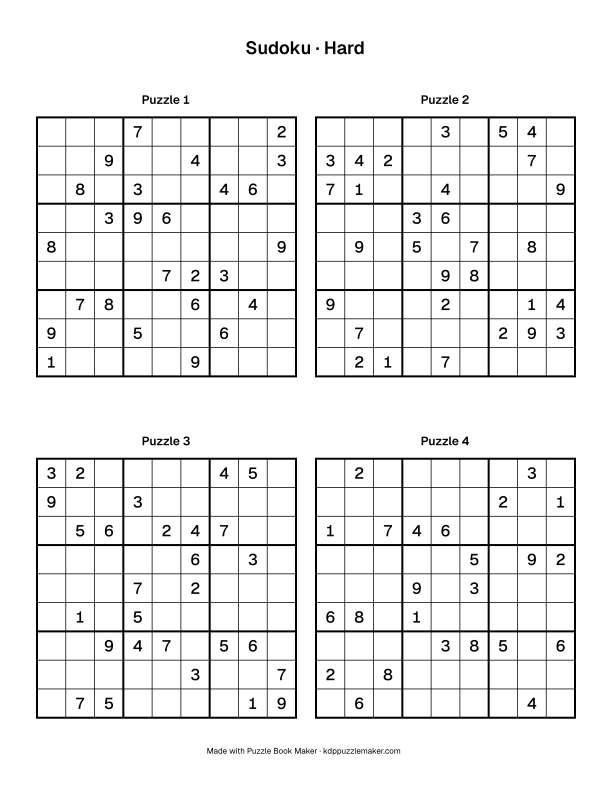
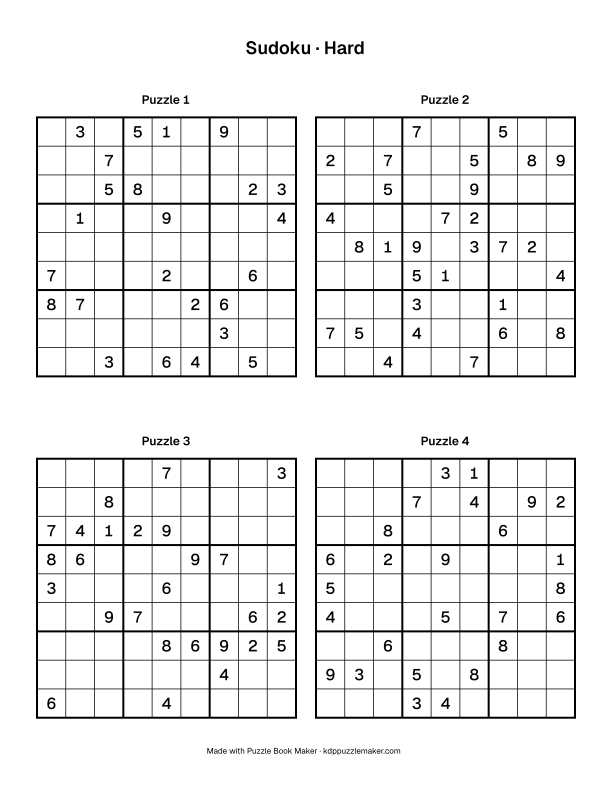
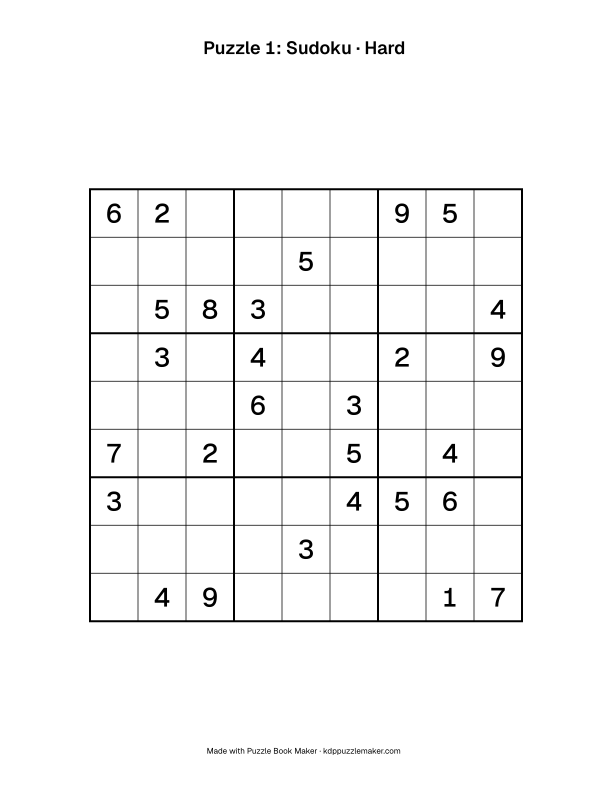
First page of the hard sudoku, one per page (4 puzzles): a 9 × 9 sudoku grid with its given digits.

Hard sudoku, one per page (4 puzzles)

Four hard sudoku, one to a page, with cells large enough for full candidate notes. Each puzzle has its answer page at the back.

Level
Hard
Per page
1 puzzle
Puzzles
4 puzzles
For
Experienced solvers

Includes answer key at the back

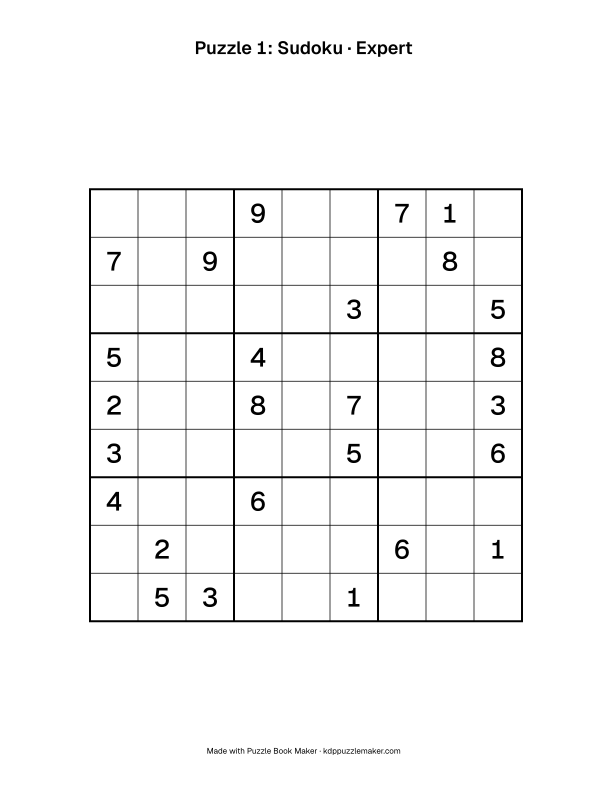
First page of the expert sudoku, one per page (4 puzzles): a 9 × 9 sudoku grid with its given digits.

Expert sudoku, one per page (4 puzzles)

Four expert sudoku, the hardest level we make, one to a page with room for every candidate, and the answers at the back.

Level
Expert
Per page
1 puzzle
Puzzles
4 puzzles
For
Expert solvers

Includes answer key at the back

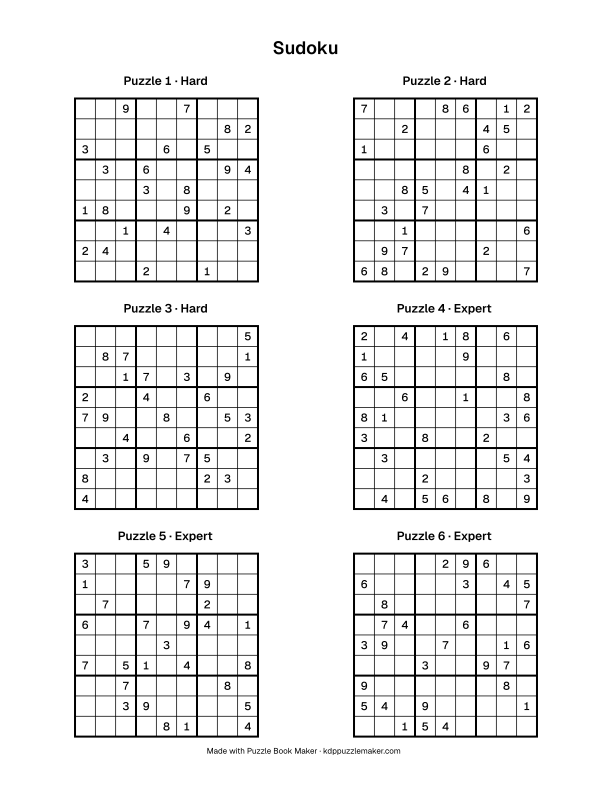
First page of the hard and expert sudoku pack (24 puzzles): four 9 × 9 sudoku grids with their given digits.

Hard and expert sudoku pack (24 puzzles)

24 puzzles on six sheets, four to a page: twelve hard, then twelve expert, with all six answer sheets at the back.

Level
Hard and expert
Per page
4 puzzles
Puzzles
24 puzzles
For
Experienced and expert solvers

Includes answer key at the back

Need a harder challenge every day?

The sudoku generator opens at the hard level. Switch to expert for the toughest band, and each puzzle lists the hardest step its solve needed.

Get new puzzles

What hard and expert puzzles need

Every hard puzzle here needs at least one naked triple, hidden triple, X-wing, skyscraper or 2-string kite, on top of the singles, pairs and pointing that medium puzzles use. Triples extend the pair idea to three squares and three digits. The others are fish and chains: a candidate whose positions in two rows (or two columns) are tied together, so whichever way it falls, some squares lose it.

Expert puzzles need at least one swordfish, XY-wing or XYZ-wing. A swordfish is the three-row cousin of the X-wing; the two wings look for squares with two or three candidates that see each other and squeeze one digit out of a square they both see.

The pack is 24 puzzles, the first half hard and the second half expert, so it works as a course: finish the hard sheets before you turn the page.

A worked tip: the X-wing

Pick a digit, say 3, and look along every row for one where 3 has exactly two candidate squares. Suppose row 2 allows 3 only in columns 4 and 8, and row 7 allows it only in the same two columns. The 3 of row 2 is in column 4 or 8, and so is the 3 of row 7, and they can’t share a column. So between them they fill columns 4 and 8. Every other 3 candidate in those two columns can be crossed out.

The four squares make a rectangle; that is the shape to look for. Check one digit at a time, rows first, then columns, and you will find an X-wing far more often than you expect.

Working through the expert sheets

Expert puzzles reward a routine. Fill in every candidate first, then sweep the grid in the same order each time: singles, then pairs and pointing, then triples, then one digit at a time for fish, and only then the squares with two or three candidates for wings. Most of an expert solve is still easy moves; the hard step is usually one or two moments in the middle. When you find it, note which pattern it was in the margin. After a few sheets you will start to see where each kind tends to hide.

Who these puzzles suit

Hard and expert sheets are for confident solvers who have outgrown medium, for puzzle club members who like comparing methods, and for anyone who wants one long puzzle a day rather than several quick ones. If medium puzzles still slow you down, medium printable sudoku is the better place to practise first.

Stuck on a hard puzzle?

  • Recheck your candidates. A wrong candidate is the usual culprit. Compare every square against its row, column and box before looking for anything clever.
  • Hunt one digit at a time. Fish patterns appear when you study a single digit across the whole grid; shade its candidates lightly if it helps.
  • Look at squares with two candidates. Wings and chains are built from them.
  • Take a break. A fresh look often finds the pair you passed over.

For other levels, the sudoku printables page has a sampler and a large print set.
  • Printable sudoku

    Free sudoku PDFs from easy to expert, 1 to 6 per page, every one with its answers.

  • Medium printable sudoku

    Medium sudoku for regular solvers, 1 to 6 per page, with answers.

  • Sudoku

    Sudoku from easy to expert, rated by the techniques they need, 1 to 6 per page.

  • Book builder

    A full puzzle book interior as one print-ready PDF.

Frequently asked questions

What is the difference between hard and expert?

Both need patterns across several rows or columns. Expert puzzles need at least one of the largest: a pattern that links three rows or columns at once, or a wing, where three squares with few candidates pinch a digit out of a square they all see. On the mixed sheets, every puzzle’s label names its level.

Do hard puzzles need guessing?

Never. Each puzzle was solved by logic alone before it was kept, and checked to have exactly one solution. If you reach a point where only a guess seems possible, a pattern is waiting somewhere in your candidates.

Should I print one per page or four?

One per page if you write every candidate: the squares are much bigger. Four or six per page suit solvers who track candidates in their head or only note pairs.

How can I check a step without seeing the whole answer?

Fold the answer sheet so only the row you are working on shows, or cover it with a strip of paper. The answer sheets mirror the puzzle sheets, so the row is in the same place.